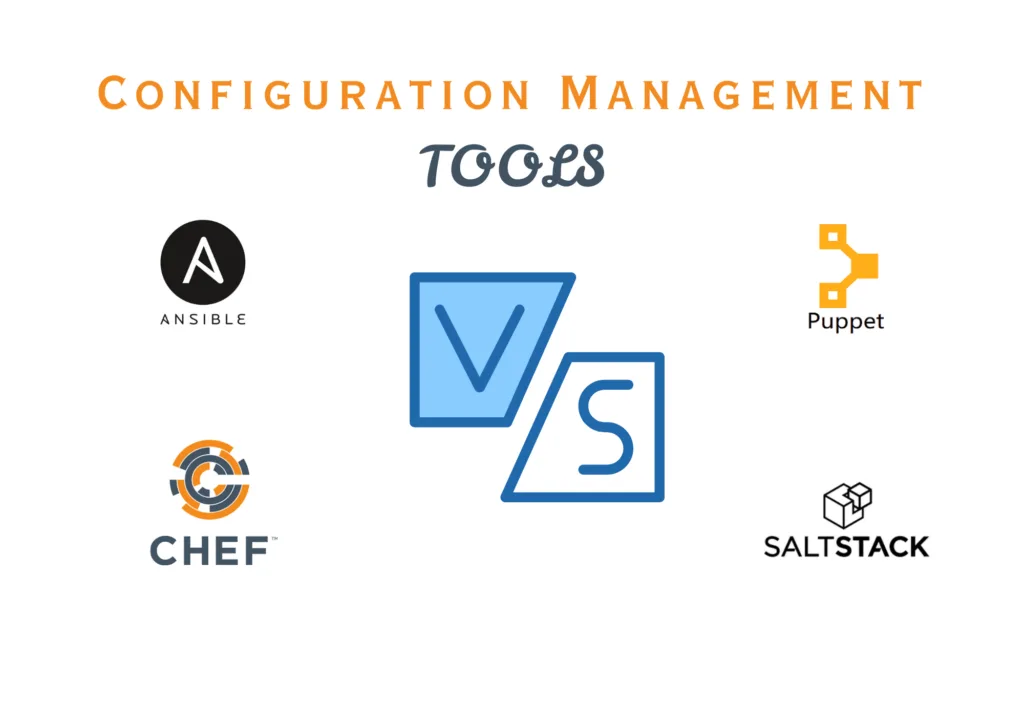
🛠️ Configuration Management Tools: Ansible vs Puppet vs SaltStack vs Chef
In modern IT environments, configuration management tools play a crucial role in automating infrastructure deployment, reducing manual work, and ensuring consistency. Among the most popular tools are Ansible, Puppet, SaltStack, and Chef. This blog explores their key differences in a tabular format. 🔍 What is Configuration Management Tools? Configuration Management Tools (CM) is a process of maintaining system settings and software configurations in a structured and automated way. It ensures that IT environments remain consistent and can be quickly restored in case of failures. 📊 Comparison Table 🏷️ Feature 🚀 Ansible 🎭 Puppet 👨🍳 Chef 🧂 SaltStack Developed By Red Hat Puppet Labs SaltStack (Acquired by VMware) Progress Software (Originally by Opscode) Agent-Based? ❌ Agentless (SSH/WinRM) ✅ Agent-Based ✅ Agent-Based (But supports agentless mode) ✅ Agent-Based Language Used 📜 YAML (Ansible Playbooks) 📝 Puppet DSL (Ruby-based) 🐍 YAML & Python 💎 Ruby (Chef Recipes) Ease of Use ⭐ Very Easy ⭐⭐ Moderate ⭐⭐ Moderate ⭐⭐⭐ Difficult Configuration Style 🏗️ Declarative & Imperative 🏗️ Declarative 🏗️ Declarative & Imperative 🏗️ Imperative & Declarative Best Suited For 🏢 Small to Large Enterprises 🏢 Large Enterprises 🏢 Large Enterprises 🏢 Large Enterprises Performance ⚡ Faster (Push model) 🐢 Slower than Ansible (Pull model) ⚡ Faster than Puppet 🐢 Slower than Ansible Scalability 📈 Moderate to High 📈 High 📈 Very High 📈 High Platform Support 💻 Linux, Windows, macOS 💻 Linux, Windows 💻 Linux, Windows 💻 Linux, Windows, macOS GUI Available? ✅ Yes (AWX/Tower) ✅ Yes ✅ Yes ✅ Yes (Chef Automate) Community Support 🌍 Very Large 🌍 Large 🌍 Large 🌍 Large Learning Curve 🎯 Easy 🎯 Moderate 🎯 Moderate 🎯 Steep Pricing 💰 Open-source & Paid 💰 Open-source & Paid 💰 Open-source & Paid 💰 Open-source & Paid 📝 Key Takeaways 🚀 Ansible is the easiest to learn and use, making it great for beginners and small to large enterprises. 🎭 Puppet is widely adopted in large-scale environments but has a steeper learning curve. 🧂 SaltStack is highly scalable and fast, suitable for enterprises with a mix of agent-based and agentless configurations. 👨🍳 Chef is powerful but has a steep learning curve due to its Ruby-based configuration. 🎯 Conclusion Choosing the right configuration management tools depends on your organization’s needs, existing skill sets, and infrastructure complexity. Ansible is preferred for its simplicity, while Puppet and Chef are ideal for complex enterprise environments. SaltStack stands out for high-speed automation in large infrastructures. 💬 Which tool do you use or prefer? Let us know in the comments! https://srtechops.com/wp-content/uploads/2025/01/Remainder-App-Technology-Logo.mp4 Devops Multi cloud Training Choose the training style that fits your schedule — Self-Paced or Live Interactive Sessions. Both include hands-on projects, expert support, and lifetime access. Feature Self-Paced Training Live Training 🎯 Mode 🎥Pre-Recorded Session 🧑🏫Live Class + Recordings 💼 Projects 🕒 Weekend Real-Time Projects 📅 Weekdays + Weekend Real-Time Projects ❓ Doubt Clearing 📞 Weekend Live Support Session 🧠 Anytime Doubt Clearing Session 👥 Career Support & Mentorship ❌ No ✅ Yes 🎓 Global Certification Training ❌ No ✅ Yes 🔑 Access ♾️ Lifetime Access ♾️ Lifetime Access 💰 Fees ₹4,999 (2 x ₹2,500) ₹7,999 (2 x ₹4,000) ℹ️ For More Info Explore Self-Paced Training Explore Live Training
🛠️ Configuration Management Tools: Ansible vs Puppet vs SaltStack vs Chef Read More »